
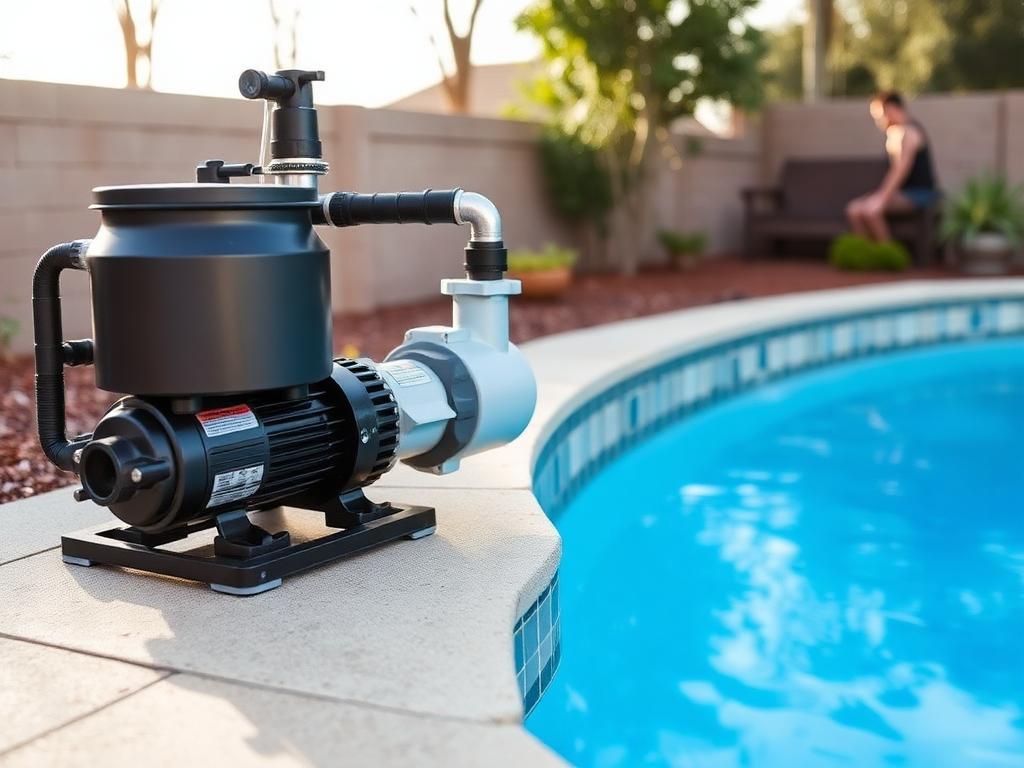
Why Vegas pumps fail faster than the brochure says
Most pool pumps are spec'd for a 7–10 year life. In Las Vegas, single-speed pumps running 8–10 hours a day in 110°F ambient heat often start failing at year 4–5. The motor windings cook, the shaft seal dries out from low water events, and the plastic volute warps from UV exposure if the equipment pad isn't shaded.
Knowing which symptom points to which failure saves you from replacing a whole pump when a $25 part would have fixed it.
The five symptoms and what they actually mean
Match the symptom to the most likely cause before you buy parts:
- Loud screeching or grinding: motor bearings are dry or worn — bearing kit ($30–$60) plus labor, or replace the motor
- Water dripping from between the motor and the wet end: shaft seal failed — seal kit is $20–$40, must be replaced before water reaches the bearings
- Pump runs but no flow or weak flow: usually air leak on the suction side, clogged impeller, or a closed valve — almost never the motor itself
- Breaker trips when pump starts: capacitor failing or motor windings shorted — start capacitor is $15–$25, run capacitor $20–$35, both easy DIY with the power off
- Pump won't start, just hums: seized impeller or dead capacitor — try spinning the shaft by hand from the back of the motor first
What's worth repairing yourself
Capacitors, shaft seals, o-rings, lid gaskets, and basket replacements are all under $50 in parts and 30–60 minutes of work with basic tools. YouTube has a video for every major pump model. The only safety rule that matters: kill the breaker, verify with a non-contact tester, then work.
Bearing replacement is the line where DIY gets harder. You need a bearing puller, the correct press procedure, and patience. If you've never done it, the labor savings rarely justify the risk of damaging the motor housing.
When repair stops making sense
If your pump is single-speed, over 6 years old, and needs more than a capacitor, replacement almost always wins. A new variable speed pump runs $900–$1,500 installed in Vegas, and NV Energy rebates can knock $200–$300 off. Energy savings alone usually pay back the difference vs. repair within 18–24 months.
Repair makes sense if the pump is variable speed, under 5 years old, or the failure is a clearly cheap part (capacitor, seal, o-ring). Throwing $400 of parts and labor at an old single-speed motor is the worst of both worlds — you keep the high electric bill and you'll be back here in 18 months.
The diagnostic order that saves time
Before you call anyone or buy any part, walk through this sequence — half the 'pump is broken' calls we get are something else entirely:
- Confirm power: breaker on, timer/automation calling for run, no GFCI tripped at the equipment pad
- Check water level: if it's below the skimmer mouth, the pump is sucking air, not broken
- Look at the pump basket and lid o-ring: clogged basket or a dry/cracked o-ring causes 'no prime' that looks like pump failure
- Inspect valve positions: a closed suction valve is the #1 cause of weak flow after equipment service
- Listen with the pump off-then-on: a clean start with rising flow is electrical/mechanical health; humming, screeching, or no movement narrows it fast
Variable speed conversion — the upgrade that pays for itself
If your single-speed pump dies and your pool is on a typical 8–10 hour summer schedule, a variable speed replacement is almost always the right call in Las Vegas. Running at low RPM most of the day uses 70–80% less electricity, and Nevada's electric rates make that savings real — typical NV Energy bills drop $40–$80/month in summer.
Pair the new pump with a basic timer or your existing automation, set it to a low RPM 'circulation' mode for most of the day with a short high-RPM 'cleaning' burst, and you'll get better filtration than the old pump delivered at full blast.
When to call us
If the symptom is electrical (breaker trips, motor hums, no start) and you're not comfortable working around 240V, skip the YouTube tutorial. A misdiagnosed capacitor swap can take out the motor, and a leaking seal that wasn't fixed in time turns a $40 repair into a $400 motor replacement.
Same goes for any pump that's been running dry, smells burnt, or has visible scorching on the motor housing — the windings are likely damaged, and the right answer is replacement, not repair.
Want us to handle it?
We'll diagnose, dose, and dial in your pool — so you don't have to remember any of this.
Get a free quote